Monitoring stations
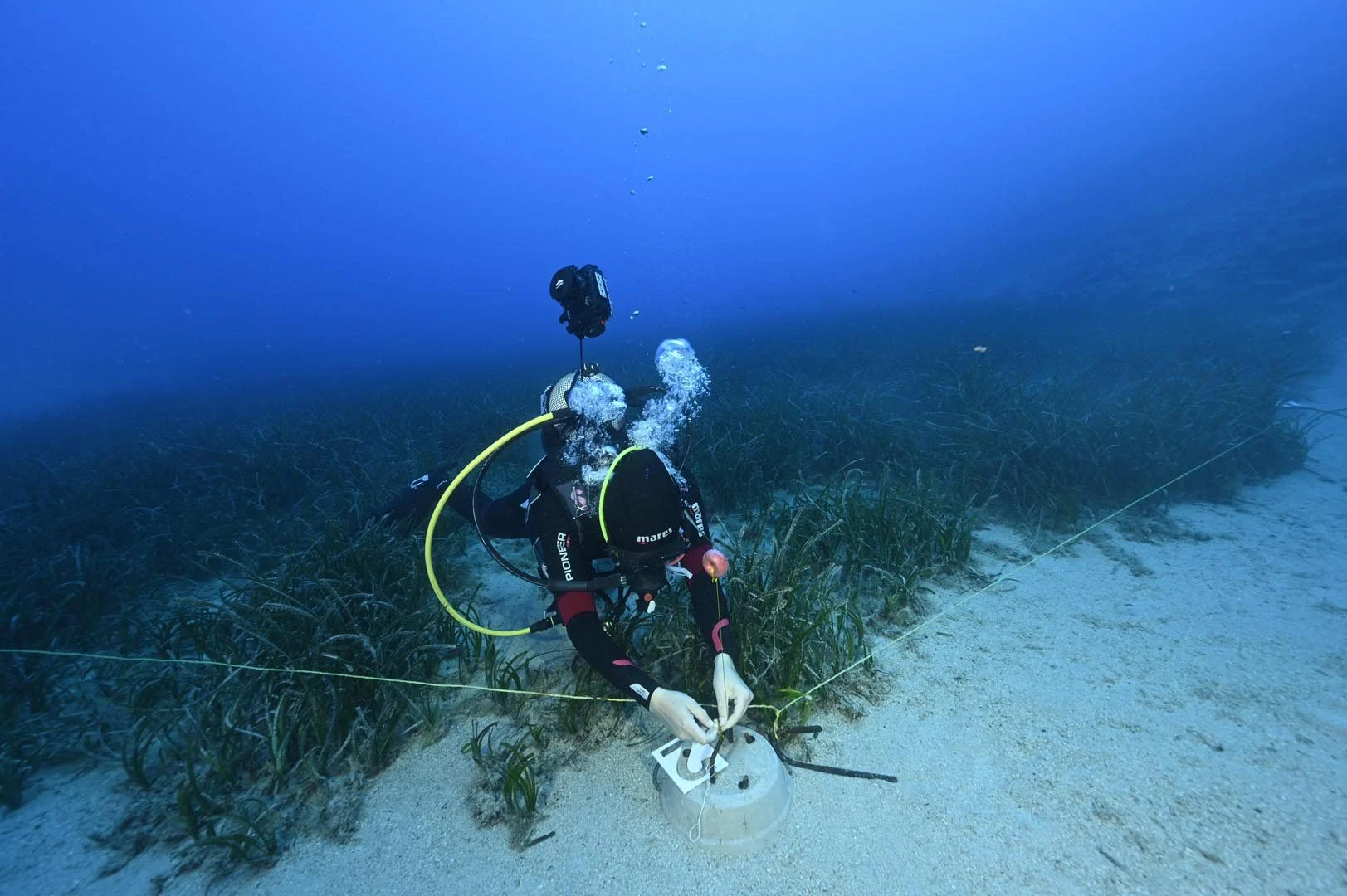
The Mediterranean Conservation Foundation establishes monitoring stations to determine the distribution and development of the Posidonia oceanica species.


Species · Marine Species
Seagrass has the highest carbon storage capacity amongst all plant habitats in the world, at 2000 tonnes/ha.
Photo: Akdeniz Koruma Vakfı Arşivi
Posidonia oceanica is endemic to the Mediterranean.
Seagrass has the highest carbon storage capacity amongst all plant habitats in the world, at 2000 tonnes/ha.
90% of seagrass habitats in the Mediterranean have been damaged.
The formation and development of seagrass meadows take many years.
The Mediterranean Conservation Foundation establishes monitoring stations to determine the distribution and development of the Posidonia oceanica species.
Seagrass meadows are flowering plants that are widely scattered globally, and that have adapted to live rooted in the ocean floor (sediment). They form structures resembling roots, stems, and leaves, anchoring themselves to the seabed and producing their own food through photosynthesis with the help of sunlight. As a result of photosynthesis, they serve as a source of oxygen and nutrients in the oceans and provide critical spawning grounds for many fish species that lay their eggs among these plants. The formation and development of seagrass meadows take many years. Scientific studies have shown that attempts to artificially replant seagrass meadows have not been successful.
10-30 metreAverage depth to which Posidonia oceanica has receded along our coasts
Posidonia oceanica meadows can support a relatively wide range of temperatures, as deduced from the wide latitudinal range of their distribution. Therefore, although no specific experiments have been conducted, from this latitudinal distribution we can deduce that the plant endures temperatures from approximately 10°C to 29°C.
Since visibility is crucial for photosynthesis, Posidonia oceanica needs transparent, oligotrophic and oxygenated waters to survive. Its vertical distribution is limited by light. Posidonia oceanica can live within a narrow salinity range of 33-39‰, but populations in the Eastern Mediterranean Basin may also be living at higher salinity levels.
Seagrass uses its roots to anchor itself to the seabed and to take up nutrients. Sediments must be relatively anoxic. It can grow on rocky or sandy bottoms. Muddy layers are unsuitable for its growth, because the seagrass cannot anchor itself to the ground and the water is too turbid for it to grow. In this respect, the balance between sedimentation and erosion greatly limits meadow development. Wave action is another important criterion: in shallow bays, seagrass can grow up to the water surface and form fringing reefs, but on open coasts it generally begins to grow a few metres below the surface.
A conspicuous and complex epiphytic community lives on the leaves of Posidonia oceanica. Within this community there are more than 94 species identified as micro and macro algae. More than 44 species of sessile animals such as hydroids have also been identified, and more than 90 species of accumulating bryozoans have been found, which are also a common component of the leaf epiphytic community. The presence of the large fan mussel Pinna nobilis, listed as “Critically Endangered” (CR) on the Red List published by the International Union for Conservation of Nature (IUCN), is a good indicator of water quality and mechanical stability within the meadows (owing to its filter-feeding habits, long lifespan and slow growth).
More than 70 algae species (mostly red algae), adapted to low light intensity, colonise Posidonia oceanica rhizomes. 185 species of molluscs and 120 species of crustaceans (copepods, decapods and amphipods) are the most abundant faunal groups in Posidonia oceanica meadows. Polychaeta are very abundant in the meadows; more than 180 species have been identified. Sponges are abundant in the rhizome substrate (more than 15 species). The meadows are also home to 16 species of sea cucumbers, which play a significant ecological role as sediment filterers.
Seagrass meadows provide a refuge for fish species to protect themselves. Many fish species live in the meadows until they reach adulthood. The herbivorous green turtle Chelonia mydas also feeds on seagrass.
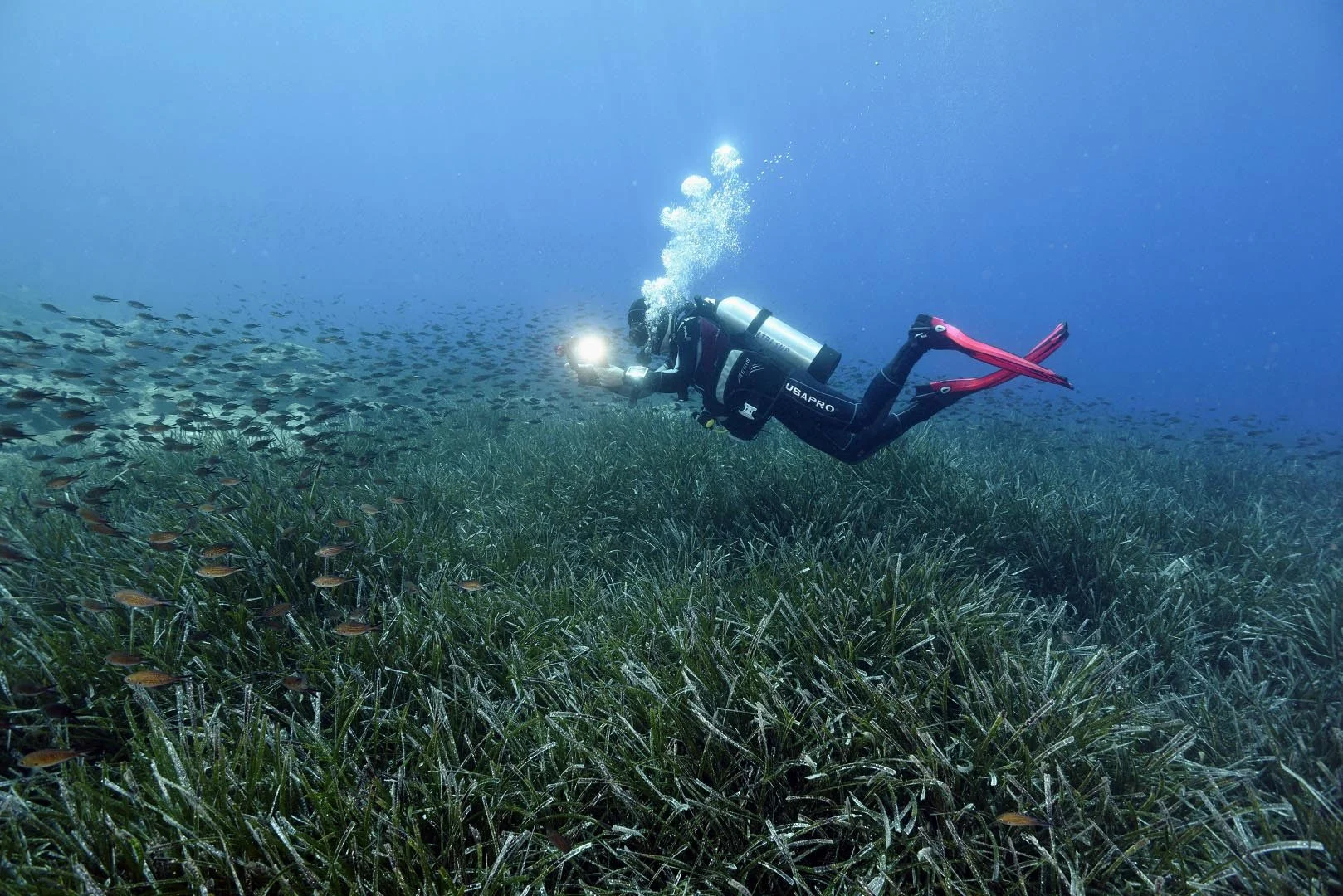
2000 ton/haCarbon storage capacity of seagrass — the highest of all plant habitats
90% of seagrass habitats in the Mediterranean have been damaged.
For this species
The Mediterranean Conservation Foundation establishes monitoring stations to determine the distribution and development of the Posidonia oceanica species.
Through ghost net clean-up efforts, fishing gear and other solid waste that cover seagrass beds, reducing light and oxygen permeability, are being removed from this habitat.
In addition, the Foundation investigates the amount of carbon that seagrass (Posidonia oceanica) stores in sandy sediment through its roots.
Through the Marine Ranger System, it warns boats not to anchor on seagrass beds within Marine Protected Areas.
Through its awareness-raising activities, it aims to increase knowledge about the species.