
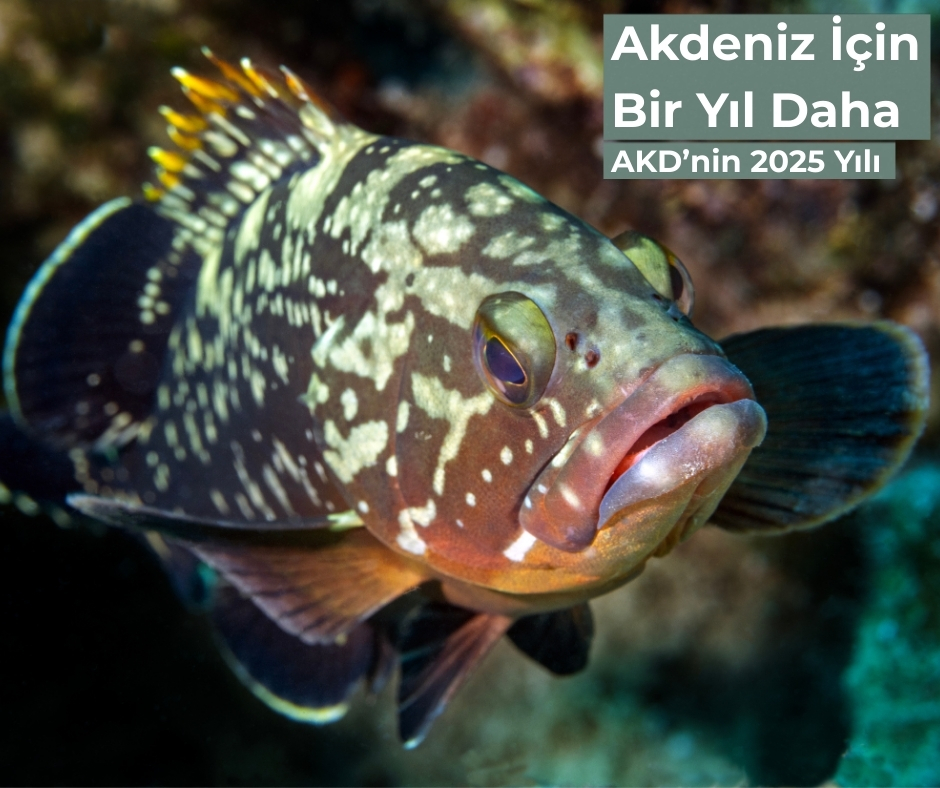
In 2025, Akdeniz Koruma Derneği (Mediterranean Conservation Society – AKD) continued its work with the vision of a Mediterranean ecosystem where all living beings coexist in balance and harmony. Throughout the year, we brought together a science-based, nature-based conservation approach with local knowledge and community participation, carrying out intensive work that found tangible expression at sea, along coastal areas, within protected sites, across scientific monitoring processes, and in schools.
Together with our professional team, local partners, and volunteers, we implemented numerous initiatives focused on the protection of marine ecosystems, monitoring biodiversity, identifying the sources of plastic pollution, strengthening children’s and young people’s connection with the sea, and addressing the challenges posed by non-indigenous species.
Throughout the year, our Marine Ranger System once again demonstrated the critical importance of continuity and effective monitoring within No-Take Zones. Our Marine Rangers conducted 1,022 patrols across different regions, spending more than 3,579 hours in the field and covering over 24,115 kilometers. As a result of these regular patrols, 1,650 illegal activities were identified and reported to the relevant authorities, 1,014 of which were recorded as illegal fishing activities.
Scientific monitoring remained one of AKD’s core areas of work in 2025. Our expert teams carried out multi-component, long-term monitoring activities in the Gökova, Fethiye–Göcek, Datça–Bozburun, Kaş–Kekova, and Foça Specially Protected Areas. In addition to monitoring target species, we regularly tracked seawater temperature, pH, and water quality parameters. Fish biomass monitoring studies revealed clear differences between protected areas and adjacent non-protected zones, providing valuable scientific evidence on the positive effects of long-term protection on ecosystem health. Annual underwater visual census surveys conducted in Gökova, Fethiye–Göcek, Kaş–Kekova, and Datça–Bozburun formed the foundation of these assessments.
As part of acoustic monitoring studies targeting the invasive lionfish (Pterois miles), ten tagged individuals were tracked across nine stations in Ayın Cove, with receivers checked regularly every six months.
To identify the sources of plastic pollution within our areas of work, we conducted seasonal field surveys at a total of 23 monitoring stations. Macro- and meso-plastic sampling was completed across two coastal and two underwater stations. These efforts not only documented current conditions but also laid the groundwork for a long-term monitoring program to be implemented in the coming years.
During 2025, we carried out eight diving operations, successfully removing a total of 1,750 kilograms of marine debrisfrom the sea.
At the same time, we implemented citizen science initiatives involving local communities in the sampling of microplastics found on the water surface. Sampling activities conducted with local water sports centers and volunteers using paddle boards continue on a regular basis. Through these efforts, we transformed scientific processes into collective, experiential, and accessible learning opportunities rooted in direct engagement with nature.
Water quality monitoring was conducted monthly at 10 designated stations, primarily across Gökçe, Akçapınar Azmağı, Azmak, and Akyaka. To assess the impacts of seasonal variation as well as natural and anthropogenic factors, we measured key parameters including temperature, pH, dissolved oxygen, electrical conductivity, salinity, and nutrient levels (ammonium and nitrate nitrogen). Additionally, to monitor groundwater level fluctuations within the Gökçe wetland, we installed groundwater monitoring equipment. Three groundwater monitoring devices were embedded at approximately one meter depth across three stations, enabling continuous tracking of groundwater level changes.
Marine habitat monitoring activities continued with annual assessments of seagrass meadows (Posidonia oceanica) at 13 stations. In addition, Posidonia oceanica transplantation (restoration) efforts were initiated at pilot sites of approximately 20 m² in Karaada and Boncuk Cove. In collaboration with local fishing cooperatives operating within our project areas, we continued monthly fisheries catch data collection to strengthen socio-ecological datasets related to small-scale fisheries.
Monitoring activities targeting the Mediterranean monk seal (Monachus monachus) continued regularly across 10 caves, while the number of remote monitoring systems deployed was increased to three.
As part of our ecosystem restoration efforts, integrating edible non-indigenous species into gastronomy remained a key focus area for AKD in 2025. Through close collaboration with small-scale fishers, we enhanced knowledge and awareness around the identification and proper handling of these species. These efforts trace back to 2015, when activities first began at the Akyaka Fisheries Cooperative with the “Delicious Invaders Festival,” organized to introduce the longtail butterfly ray to local communities. To transform this field-based approach into a sustainable model, we established the Yeni Balıklar (New Fish) social enterprise in 2020. By 2025, marking the tenth year of these initiatives, we contributed—together with small-scale fishers—to the removal of approximately 19 tons of edible non-indigenous species from marine ecosystems. Today, partnerships spanning from Bodrum to Kaş support a circular model that reduces ecological pressure while connecting fishers’ labor with the gastronomy sector. Through international collaborations, we also continued to generate scientific knowledge on the behavior of these species and their interactions with marine ecosystems.
Throughout the year, we continued our education and awareness-raising activities with participants from diverse age groups. Under our protocol with the Muğla Provincial Directorate of National Education, the Mediterranean Guardians Education Program enabled children and young people to learn through experience about the role of the seas within ecosystems, the impacts of human activities, and scientific research methods. Through activities organized in schools, in the field, and at festivals, we reached 505 students, aiming to strengthen their connection with marine environments.
In parallel, we continued producing communication and content to share the stories of the seas and nature with broader audiences. At the global level, we maintained international partnerships to increase the visibility of marine conservation efforts. Within the framework of the Revive Our Ocean initiative, we coordinated the screening and communication processes for the documentary Ocean with David Attenborough in Türkiye. Following special screenings held in Istanbul in November and Muğla in December, screenings will continue in İzmir in January. Through the documentary, we aim to engage diverse stakeholders and wider audiences on the threats facing marine ecosystems and the importance of science-based conservation approaches. This process also contributed to positioning our Mediterranean-focused work within the broader global marine conservation narrative.
In 2025, AKD’s long-standing science-based and community-centered conservation approach received international recognition. Our Chair of the Board, Zafer Kızılkaya, was honored with the 2025 Mediterranean Protector Awardpresented by the Bluewave Alliance. This recognition reflects not only individual leadership but also the collective efforts of the AKD team, local partners, and communities working together in the field.
Building on this accumulated experience and sense of responsibility, AKD completed its transition toward foundation status to strengthen the long-term impact of its work. Following a decision taken in 2023, the Mediterranean Conservation Foundation was officially established in 2025 and commenced its activities. This transition aims to carry forward the scientific knowledge, field experience, and collaborative networks developed under the association into a more permanent, inclusive, and sustainable institutional structure, enabling a more strategic and long-term perspective on conservation along Türkiye’s Mediterranean coasts.
In 2025, we expanded our work beyond Specially Protected Areas by implementing a preliminary ecosystem restoration project in İzmir’s Gülbahçe Bay, bringing together all relevant stakeholders needed for restoration efforts. The project’s primary partners—and leaders in remapping the area—were women from Özbek Village.
Drawing on years of field experience gained through marine ranger operations and volunteer-supported fire prevention efforts, we shifted our focus toward the restoration of habitats damaged by wildfires. In Marmaris’ İçmeler region, we launched a new project under the leadership of the Marmaris Municipality, aiming to address damage across both terrestrial and marine ecosystems.
For Akdeniz Koruma Derneği, 2025 reaffirmed the importance of continuity, collaboration, and patient, long-term conservation. In the coming period, guided by science and in partnership with local stakeholders, we will continue working to protect the Mediterranean’s natural and cultural heritage.
You can continue to support our work in the new year through the certificates we have prepared.
Please click here to view our certificates.