Impact of ash on acidification
In this context, we began monitoring work with our international partners on the effects on ocean acidification of the ash that reaches the seas with the first rains after forest fires.


Field programme · Climate Change
While forest fires caused severe damage to the region’s ecosystem, the need for serious work to rehabilitate the area after the fires became apparent.
Photo: Akdeniz Koruma Vakfı Arşivi
During the forest fires on the southern Aegean coasts of Türkiye, we supported the firefighting efforts with the contributions of volunteers and donors.
While forest fires caused severe damage to the region’s ecosystem, the need for serious work to rehabilitate the area after the fires became apparent.
In this context, we began monitoring work with our international partners on the effects on ocean acidification of the ash that reaches the seas with the first rains after forest fires.
We will start the monitoring work in May 2023 and follow it for one year.
During the forest fires on the southern Aegean coasts of Türkiye, we supported the firefighting efforts with the contributions of volunteers and donors. Within the Marine Stewardship System we run in the region, our Marine Stewards worked in coordination with the teams responsible both for extinguishing the fire and for evacuating people from the area.
Impact of forest fires on terrestrial and marine species
In this context, we began monitoring work with our international partners on the effects on ocean acidification of the ash that reaches the seas with the first rains after forest fires.
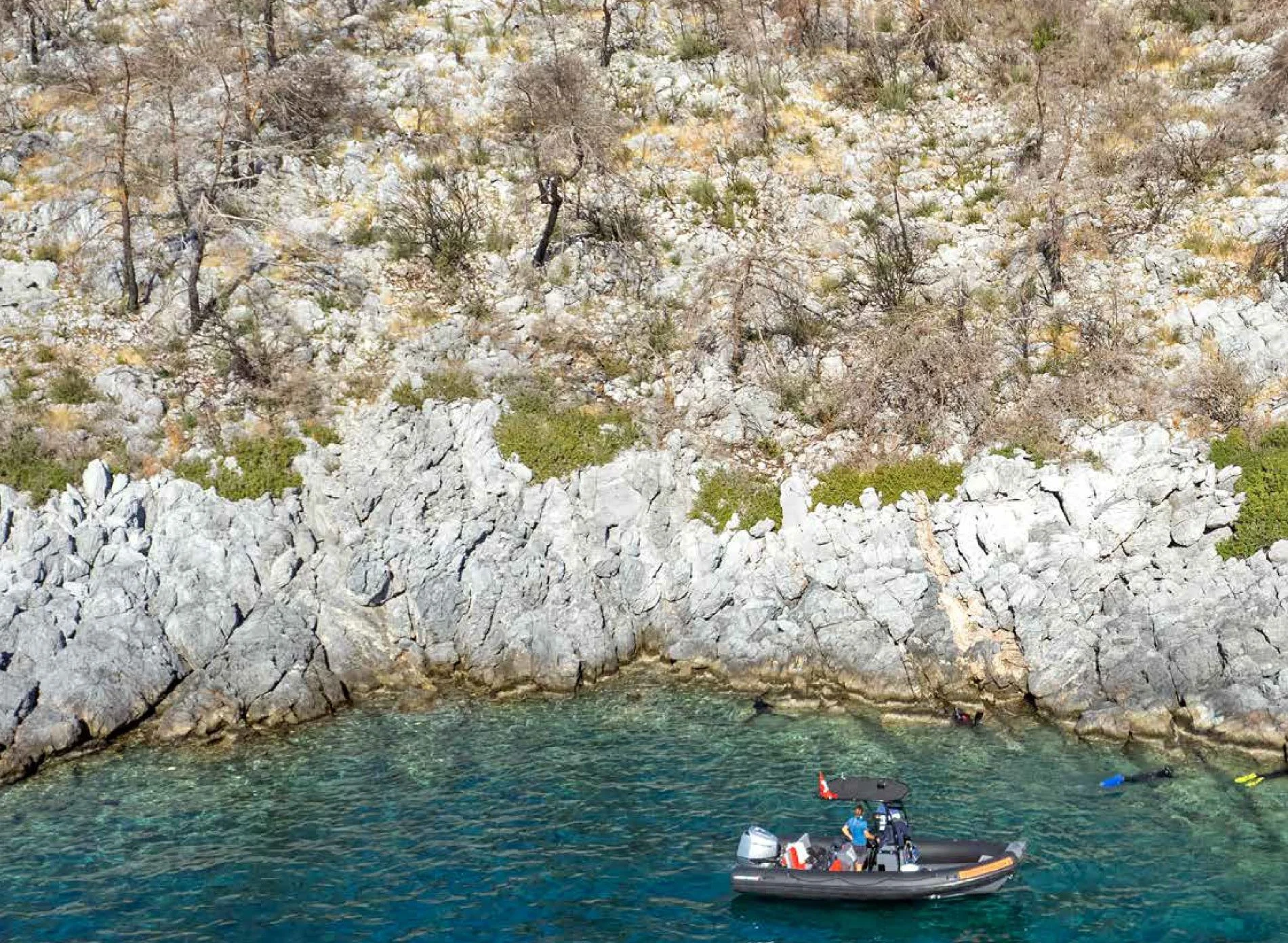
In 2022, we hosted in our study areas Dr Simone Farina from the Stazione Zoologica Anton Dohrn–National Institute of Marine Biology, Ecology and Biotechnology Department of the Genoa Marine Centre (GMC) Institute, and Laura Tamburello and Federica Ragazzola from the Stazione Zoologica Anton Dohrn Institute in Naples. They were invited to share the data and methods of their project investigating the effects of the 2021 fire in the Sardinia region of Italy, and to carry out a joint study in Göcek and Gökova Bay to investigate the effects on marine environments of the fire that occurred in Gökova Bay in the summer of 2021. The monitoring work, which lasted a total of 6 days, was carried out by SCUBA diving and snorkelling.
As a result of the work carried out, we developed a common method so that the monitoring work to be carried out in Sardinia and Gökova can be compared, and we jointly prepared the work-time schedule for the monitoring work.
We will start the monitoring work in May 2023 and follow it for one year.