

Mediterranean Conservation Foundation
TREN
Support us

Field programme · Ecosystem Restoration

New Fish

New fish are alien species that entered the Mediterranean from the Red Sea and the Indian Ocean following the opening of the Suez Canal in 1869.

Photo: Akdeniz Koruma Vakfı Arşivi

Start
2015
Where
Gökova Bay, Fethiye-Göcek, Datça-Bozburun and Kaş-Kekova Special Environmental Protection Areas
With whom
small-scale fishers and fisheries cooperatives; volunteer chefs; universities
Economic Enterprise
August 2020

At a glance

  1. New fish are alien species that entered the Mediterranean from the Red Sea and the Indian Ocean following the opening of the Suez Canal in 1869.

  2. Warming sea temperatures due to climate change have provided suitable habitats for these species in the Mediterranean ecosystem.

  3. As an edible species, lionfish can help balance the ecosystem by finding a place on the table, and can provide income for traditional fishers.

  4. Within this framework, 18 tonnes of new fish were purchased and removed from the ecosystem between August 2020 and December 2024.

18 ton
New fish purchased and removed from the ecosystem between August 2020 and December 2024
1869
Opening of the Suez Canal

About

The New Fish Programme is a project of the Mediterranean Conservation Foundation that aims, within the framework of ecosystem restoration, to increase the consumption of edible invasive and alien marine species by giving them value, thereby reducing the pressure these species exert on marine ecosystems and enabling small-scale fisheries to generate economic income from them.

1869Opening of the Suez Canal

What are invasive species?

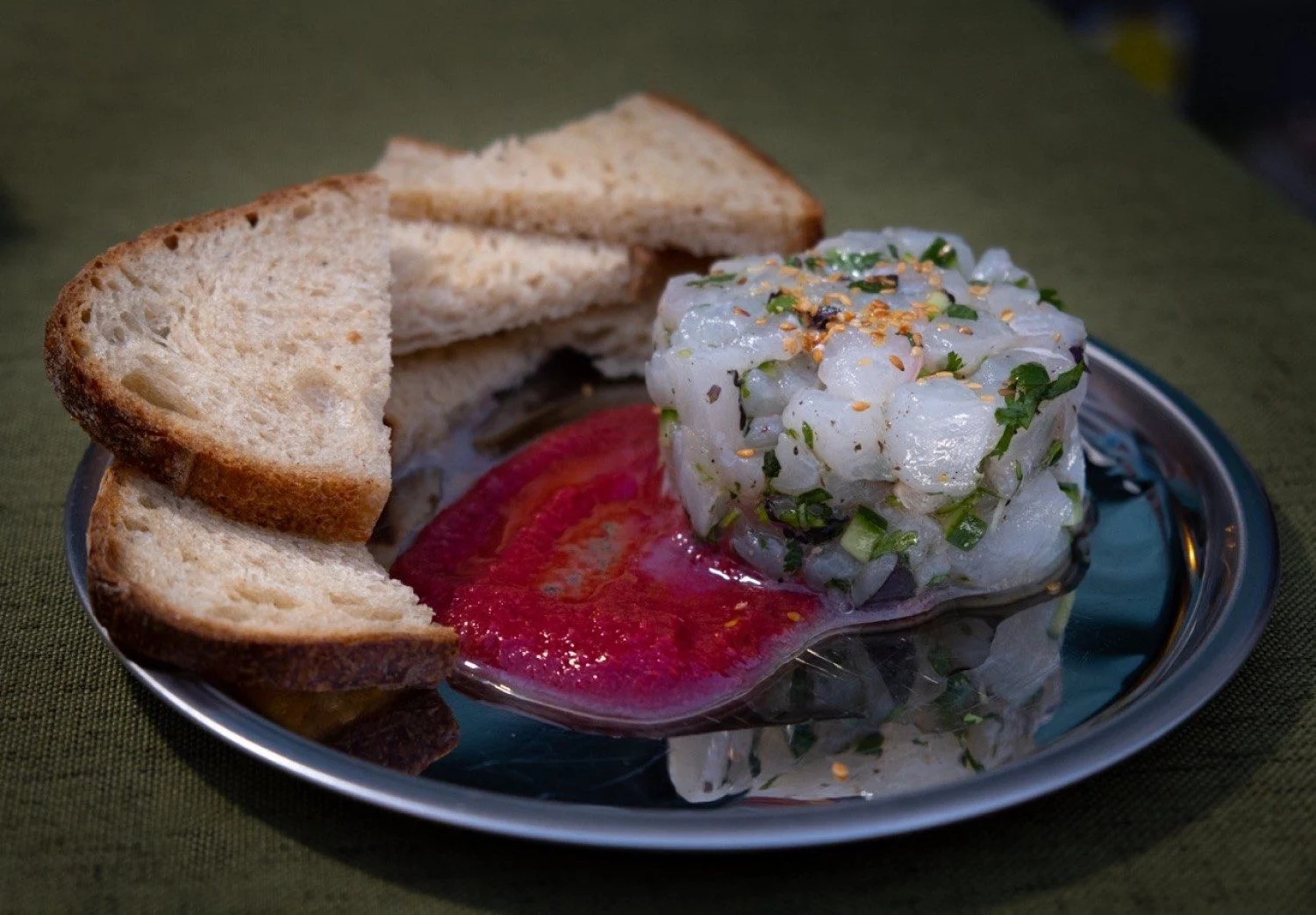
A plate of dishes prepared from new fish, served with slices of bread and beetroot sauce
Photo: Akdeniz Koruma Vakfı Arşivi

New fish in our seas

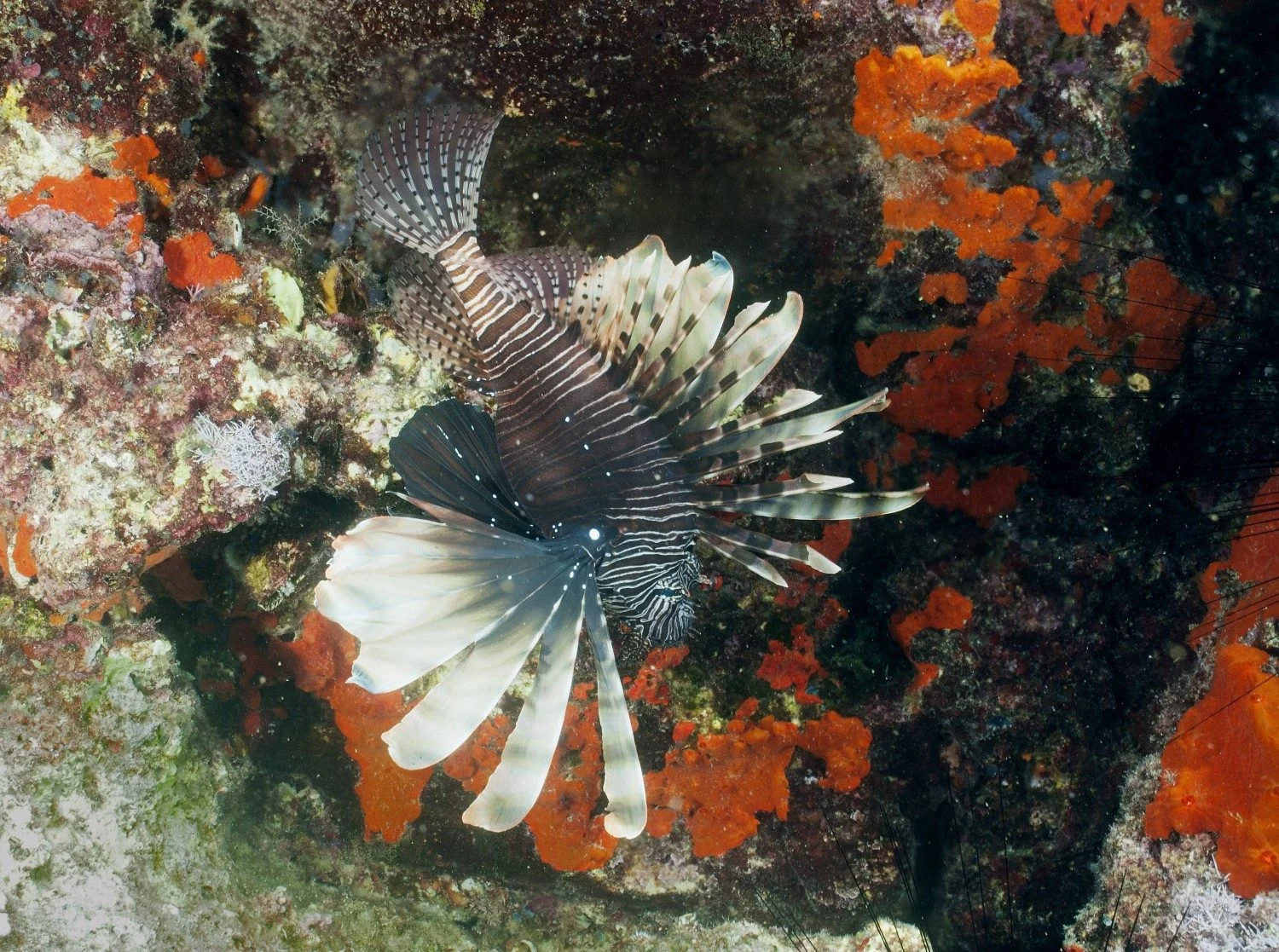
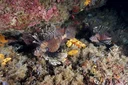
  • A lionfish with its fins spread over a colourful rocky reefLionfishPterois miles

    Native to the Indian and Pacific Oceans, this species inhabits reefs and rocky areas. It has spread to Türkiye's Eastern Mediterranean and Aegean Seas, and was recorded in Edremit Bay in 2023. Feeding on juvenile fish, crustaceans and invertebrates, this invasive species harms ecosystems, and it is also spreading rapidly because of the overfishing and illegal hunting of species such as grouper, lagos and grida. As an edible species, lionfish can help balance the ecosystem by finding a place on the table, and can provide income for traditional fishers. This fish is not poisonous in itself, but its dorsal and ventral spines must be cut off carefully with scissors and gloves. It is important not to touch the spines, as they may be venomous. In the event of a sting, a hot-water compress should be applied to the area to prevent the venom from spreading.

  • Red-striped redcoats lined up in front of a rocky creviceRedcoatSargocentron rubrum

    Also reported in the Sea of Marmara in 2018, the redcoat is one of the first species to have spread into the Mediterranean. It lives in rocky areas, bays and lagoons at depths of 10-40 metres, and may be found in small groups or alone. It feeds on benthic crabs, shrimp and small fish. Native to the Indian and Pacific Oceans, the redcoat has spread through Türkiye's Eastern Mediterranean, Sea of Marmara and Aegean Sea, and lives on rocky and coastal reefs. It is also known by names such as onionfish, nylon fish, Indian fish, squirrelfish and firefish.

  • Lessepsian lizardfishSaurida lessepsianus

    Known locally as sand fish, this species belongs to the Eastern Indian Ocean. It lives on the sandy or muddy bottoms of coastal waters and on soft seabeds. By feeding on bottom-dwelling invertebrates, small juvenile fish and crustaceans, it competes with native fish species and negatively affects the ecosystem.

  • Randall's threadfin breamNemipterus randalli

    Randall's threadfin bream was first recorded in Türkiye in 2007 in Iskenderun Bay and has increased in numbers in this area. Reaching the Mediterranean from the Western Indian Ocean via the Red Sea, the species has spread to Lebanon, Egypt and Türkiye. Also known locally as "Öylesi" or "Tel kuyruk mercan", it lives in sandy and muddy areas and is especially widespread in the Eastern Mediterranean and the Aegean Sea. It feeds on small fish and benthic invertebrates.

  • Blue-barred parrotfishScarus ghobban

    Adults live on lagoon and seashore reefs, usually alone, although the species is sometimes also found in small groups. Males live at a depth of 10 metres along reef edges, while females prefer deeper waters. Juveniles live in groups in coastal areas, on algal reefs. Also known as parrotfish and blue parrotfish, this species belongs to the Indian and Pacific Oceans and is widespread in Türkiye's Eastern Mediterranean and Aegean Sea. It feeds by scraping algae from rocky and coral reefs.

  • Goldband goatfishUpeneus moluccensis

    Frequently found among the catches of commercial fishing in the Mediterranean, the goldband goatfish lives at depths of 10-120 metres on sandy, muddy and gravel bottoms. Ranging from the Red Sea to southern Oman, the species has been recorded in the Mediterranean along the coasts of Lebanon, Israel, Syria, Türkiye, Rhodes, Egypt, Cyprus and Libya, and is concentrated on the Levantine coasts. Travelling in large schools, it makes short stops to feed. It is also known as paşa barbunu, çizgili barbun and paşa pantolonu. In Türkiye it is widespread in the Eastern Mediterranean, the Sea of Marmara and the Aegean Sea, and feeds on benthic crustaceans.

  • Red Sea goatfishParupeneus forsskali

    One of the common species of the Red Sea, this goatfish lives in sandy areas, seagrass beds, and rocky and coral reefs. Adults prefer reef areas, while juveniles and young fish prefer shallow sandy shores and seagrass beds. It is also known as the black-striped goatfish and the striped goatfish. Native to the Indian and Pacific Oceans, this species is widespread in the Eastern Mediterranean and the Aegean Sea and feeds on benthic invertebrates.

  • Dusky spinefootSiganus luridus

    It is seen in groups near the seabed in shallow water. It generally prefers hard sandy bottoms packed with rock and covered with vegetation. Adults are seen alone or in small groups (3-4 individuals), while juveniles and young fish form much larger groups. There is venom in its dorsal, anal and pelvic fins.

  • Marbled spinefootSiganus rivulatus

    It is distributed in sheltered bays and on rocky or algae-covered bottoms. It forms schools of roughly 50 to several hundred individuals down to a maximum depth of 60 m. It is one of the first invasive species on our coasts. It is an edible fish of economic value. Its length generally ranges between 15 and 20 cm. It carries venom glands in its dorsal and ventral fins.

  • Bluespotted cornetfishFistularia commersoni

    The bluespotted cornetfish is a species that has spread into the Mediterranean along the coasts of Türkiye. Its first record in the Mediterranean was made in Israeli waters in 2000, and in Türkiye in 2002. It is a fish found in shallow coastal waters along coral and rocky reefs, or on sandy or seagrass bottoms near reefs. It moves alone or in schools of 10-20 individuals.

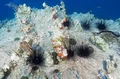
  • Long-spined sea urchins clustered on a rocky seabedLong-spined sea urchinDiadema setosum

    This species is found in abundance in the northern part of the Gulf of Suez and is thought to have been carried into the Mediterranean via the Suez Canal and ships' ballast water. It was first reported in 2006 on the coasts of the Kaş Peninsula in Türkiye. Its range in the Eastern Mediterranean has expanded. It must be handled with care because of its venomous spines; the spines cause pain when they penetrate. However, apart from defending itself, it does not attack other creatures. It can live in a wide range of environmental conditions in temperate and warm regions, particularly at temperatures above 25°C, and adapts to environmental changes.

  • Blue crabCallinectes sapidus

    The blue crab, which reached the coasts of Türkiye via the Strait of Gibraltar, is native to the Atlantic. The Atlantic blue crab has spread along the western coasts of the Atlantic Ocean and the waters of the Gulf of Mexico as far as the Aegean and Mediterranean coasts. It entered the Mediterranean in 1947, although it may have arrived in the Aegean Sea as early as the early 1930s. Since then it has expanded its spread along the Mediterranean, Black Sea and European coasts. It has dense populations in the lagoons between the Aegean Sea and Lake Köyceğiz, and is also found in the Dalyan lagoon, Akbük and the Menderes estuary.

New Fish

What we do

Monitoring, management and collaboration with chefs

To mitigate the effects of the climate crisis, the Mediterranean Conservation Foundation has worked since 2015 to monitor and manage edible invasive and alien species. It implements the Marine Ranger System in no-fishing zones to protect important species such as grouper and lagos, and at the same time collaborates with volunteer chefs to include new fish on restaurant menus in Türkiye. These species are served with different recipes in cities such as Istanbul, İzmir and Ankara, while their feeding behaviour and populations are researched in collaboration with universities.
Catching with traditional methods

By encouraging the catching of new fish species with traditional fishing methods in the Gökova Bay, Fethiye-Göcek, Datça-Bozburun and Kaş-Kekova Special Environmental Protection Areas, the Mediterranean Conservation Foundation's New Fish Programme aims to support fishers and to remove from the seas these species that harm the marine ecosystem.

Economic Enterprise and cold chain

In August 2020, the Mediterranean Conservation Society established its Economic Enterprise by creating a conservation- and nature-based business model within the New Fish programme. The Mediterranean Conservation Society Economic Enterprise purchases the new fish of our seas from small-scale fishers and fisheries and aquaculture cooperatives in the regions where we work, and delivers them to restaurants within a cold chain. Within this framework, 18 tonnes of new fish were purchased and removed from the ecosystem between August 2020 and December 2024.

Tasting events

In addition, within the programme, small-scale fishers earn income by catching these species, and through tasting events held with volunteer chefs the public becomes familiar with the new fish species, contributing to these species finding a place in kitchens and to raising awareness. In this way, pressures on local species and the ecosystem are reduced and economic benefit is generated.

01Monitoring, management and collaboration with chefs

To mitigate the effects of the climate crisis, the Mediterranean Conservation Foundation has worked since 2015 to monitor and manage edible invasive and alien species. It implements the Marine Ranger System in no-fishing zones to protect important species such as grouper and lagos, and at the same time collaborates with volunteer chefs to include new fish on restaurant menus in Türkiye. These species are served with different recipes in cities such as Istanbul, İzmir and Ankara, while their feeding behaviour and populations are researched in collaboration with universities.

02Catching with traditional methods

By encouraging the catching of new fish species with traditional fishing methods in the Gökova Bay, Fethiye-Göcek, Datça-Bozburun and Kaş-Kekova Special Environmental Protection Areas, the Mediterranean Conservation Foundation's New Fish Programme aims to support fishers and to remove from the seas these species that harm the marine ecosystem.

03Economic Enterprise and cold chain

In August 2020, the Mediterranean Conservation Society established its Economic Enterprise by creating a conservation- and nature-based business model within the New Fish programme. The Mediterranean Conservation Society Economic Enterprise purchases the new fish of our seas from small-scale fishers and fisheries and aquaculture cooperatives in the regions where we work, and delivers them to restaurants within a cold chain. Within this framework, 18 tonnes of new fish were purchased and removed from the ecosystem between August 2020 and December 2024.

04Tasting events

In addition, within the programme, small-scale fishers earn income by catching these species, and through tasting events held with volunteer chefs the public becomes familiar with the new fish species, contributing to these species finding a place in kitchens and to raising awareness. In this way, pressures on local species and the ecosystem are reduced and economic benefit is generated.

Our work on this topic

Next steps

We need your support to keep this work going.