
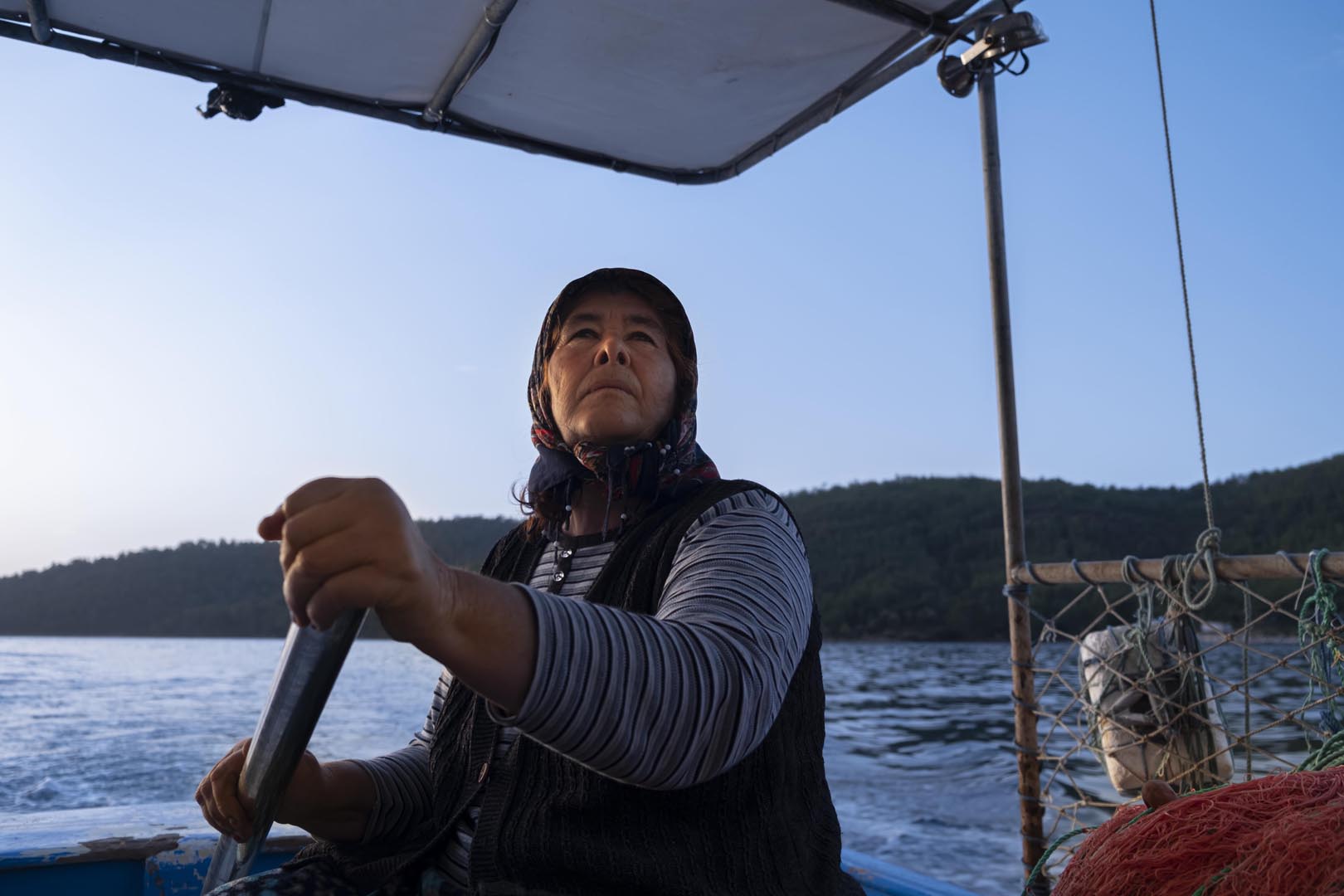
For centuries, women have been silently casting their fishing nets in Anatolia. Thousands of fisherwomen work at sea, rivers, and lakes, to keep traditional shore fishing alive.
Traditional shore fishing is one of the most beautiful examples of the relationship between nature and humanity. Women in this profession are overlooked in our country, but for centuries, men and women have been working alongside each other to keep fishing culture alive. The differing geographical properties and biodiversity of the regions where fishing is practiced also makes fishing culture diverse. The equipment used, the shape of boats, the amount of time spent in a boat, and even the food eaten while at sea are all parts of this culture… Fisherwomen of Muğla tell their children, “we cast a net and you came up,” instead of the old tale about how babies are delivered by storks. There are also various local phrases referring to life on the boat. For example, fisherwomen who are used to cooking quick and practical food, refer to this as “cooking on a pot lid.”
Small scale shore fishing, also known as traditional fishing, is practiced on seashores and inner waters with fishing boats that are less than twelve meters in length. The equipment used include guarding nets, fishing line, nets, fishing rods and tunnel nets, and traps such as plunge baskets. Readying these items for fishing purposes requires handiwork. What gives traditional fishing its name is the traditional methods and knowledge used in the creation and preparation of this equipment. The preliminary processes have different names among fishers. For example, attaching the hook to the fishing line is called “line binding,” and trying corks and lead to drag nets and shore nets is called “net rigging.” The use of these equipment varies, but they are used everywhere traditional fishing is practiced in Turkey.
The history of traditional fishing in natural and reservoir lakes, rivers, and seas in Turkey goes back further than we could know. However, there are regions where fishing began in the recent past, due to geographical constrictions and a nomadic lifestyle. Mada, the only island on Lake Beyşehir on which there is a village settlement, is one such example. Those who live on the island state that fishing was an unknown occupation to them until the 1970s, and that they used to trade fish from nearby villages with goat’s cheese. Today, men and women from almost every home on the island go fishing together. Women are involved in fishing, from the food they cook to the phrases they use, however, their existence in the profession is relatively unknown. One of the main reasons for this is the view that regards fisherwomen as crew, as well as the belief that it is sufficient for only the husband to become a member of the fishery cooperative as the owner of the boat in case of couples working together. These make fisherwomen invisible to official data and prevents the creation of fishing policies that could solve their problems. The median age of fisherwomen is forty, and most don’t have social security. It is known that fisherwomen, particularly those who go out to sea, experience chronic health problems. Perhaps the most important issue is that many women who work on boats don’t even know how to swim.
At Lake Ulubat in Bursa, women began to join the fishing industry when the highly valuable local crawfish population — also known as lake shrimp — was blighted by fungi. A fishing ban was imposed in 1986 due to the fungi infection, and until then, women had only been involved in weaving tunnel nets, which are used to catch crawfish. After this date, due to the decreased income from fishing and fishers being unable to pay their boat crew, women began to fish alongside their husbands. Some fisherwomen in the village of Gölyazı describe how they were scared to go out on the lake at first. Today, around a hundred fisherwomen from the village practice their craft on the lake.
Gülsiye Ulugedik, a fisherwoman from Gökova Bay, tells her own story: “My husband is a fisherman, so I started to work with him. I’ve been going out to sea since 1983, and for the past two years I’ve been fishing on my own. I raised my three children with the money I made thanks to this sea’s fish. I took my first child fishing with me at seven weeks old. There isn’t as much fish now as there used to be, it’s much more difficult to be a fisher at sea. In the past, when we caught thirty kilos of fish we would complain that there was no fish that day, today, it takes us three or four days to catch thirty kilo of fish. We have to work, it’s our daily bread. There is no point in sitting in front of the television.”
Despite being regarded as crew members in the profession and not fishers in their own right, women complete all the tasks required from fishers such as casting, collecting, and weaving fishing nets, and battle all the difficulties that arise. Primary amongst these difficulties is the decrease in biodiversity, and unfortunately fisherwomen are affected the greatest by this issue. The decrease of fish species in lakes, rivers, and seas due to illegal fishing, pollution, and climate change; the increase of invasive species; and the damage to shorelines mean that some fisherwomen have to go fishing alongside their husbands, while others turn away from the profession altogether. Female participation in fishing depends on the region, as well as the fishing area and the conditions of fishing boats.
These might appear to be women’s problems only, but it concerns the whole family, nature, and our country. Fisherwomen have a median age of forty, and as they retire and young people don’t join the profession to replace them, the risk of traditional fishing joining the ranks of nearly forgotten occupation is increased.
The sector is in dire need of an approach which recognises that fishing is just as important as biodiversity, and that women’s labour is no less valuable than men’s labour. Universities conducting studies on fishing, marine and inland water species and habitats, public institutions, non-governmental organisations, and fishery cooperatives are the main stakeholders when it comes to shore fishing. The decreasing number of fishers on the shores of lakes, rivers, and seas means less observational data on the subject.
The first academic study on fisherwomen in Turkey was conducted in 2008. Since 2013 the Mediterranean Conservation Society has been working with fisherwomen in the Gökova Bay in Muğla, the Datça-Bozburun SEPA, and Lake Beyşehir. The foremost aim of these efforts is to increase visibility of fisherwomen on a local and national level, and taking them into consideration when creating fishing policies.
Situation Report on Fisherwomen in Turkey
This study is based on interviews with 461 fishery cooperatives to reveal the number of fisherwomen in each region and their level of enrollment at fishery cooperatives. According to data, 61 out of the 3070 fisherwomen in Turkey fish alone, and only 414 out of 3070 are registered with a fishery cooperative. These numbers prove the lack of organisation when it comes to solving fisherwomen’s problems, the oversight that regards them as crew members, and their exclusion from official data on the subject.
Casting a net over Anatolia: Fisherwomen Project
This project, launched by the MCS at Lake Beyşehir, shows the number of fisherwomen in each region in Turkey in order to provide a basis for women-inclusive fishing policies. It aims to provide a foundation for related projects by public institutions. The fisherwomen of Lake Beyşehir were also given equipment support, and meetings were held to discuss the circumstances of fisherwomen in other regions, and gender equality related subjects. The project is funded by the GEF Small Grants Program, and run in cooperation with the Central Association of Fishery Cooperatives (SURKOOP) and Women’s Labour Appreciation Foundation (KEDV).
Author: Esra Kartal, Huriye Göncüoğlu
Photo: ©SPA/RAC, Artemisia Bodrum
Source: Magma Magazine, November 2017